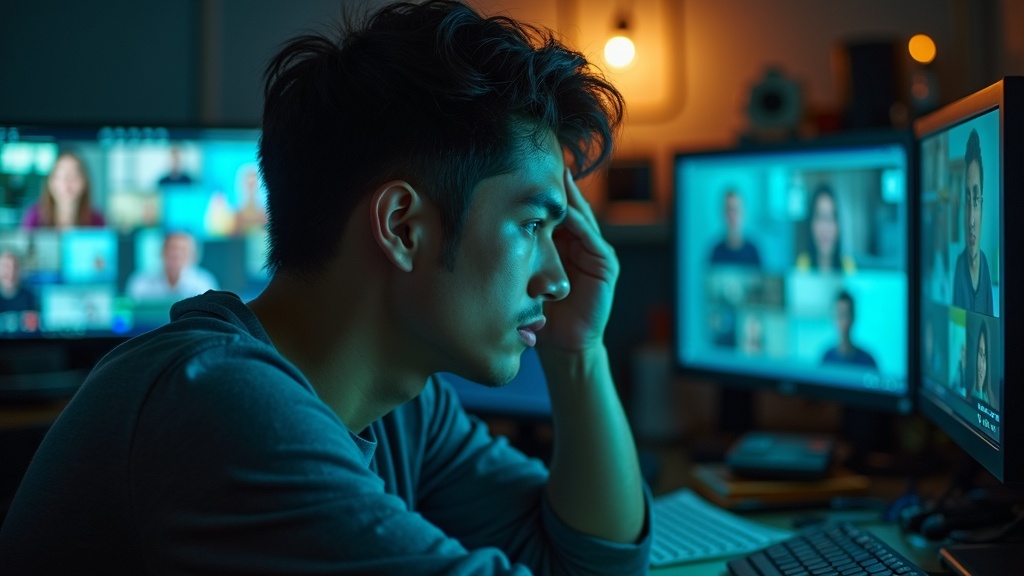
If you’ve ever finished a day of video meetings and felt completely drained, you’re not imagining things. That exhaustion is real, and it’s not because you’re bad at your job or somehow less suited to remote work than everyone else.
The truth is, video calls are genuinely more tiring than in-person conversations. Your brain and body are working overtime in ways that aren’t obvious while you’re sitting there nodding at your screen.
This phenomenon even has a name now: video meeting fatigue, sometimes called Zoom fatigue. It became impossible to ignore during the pandemic, when millions of people suddenly found themselves in back-to-back virtual meetings. What started as a convenient workaround began to feel like an endurance test.
The weird part is that video calls seem like they should be easier than commuting to an office and sitting through conference room meetings. You’re in your own home, after all. You can wear sweatpants. So why does a day of video meetings leave you feeling like you’ve run a marathon?
It turns out there are specific reasons why staring at a grid of faces takes such a toll. Some of these reasons are psychological, tied to how your brain processes social interaction. Others are surprisingly physical, related to how your eyes and body respond to screens. Together, they create a perfect storm of mental exhaustion that catches most people off guard.
Understanding what’s actually happening can help. Once you know why video meetings feel so draining, you can start to do something about it.
Seeing yourself on screen keeps you in self-monitoring mode
Think about the last time you had coffee with a friend. You probably weren’t thinking about what your face looked like while you talked. You weren’t checking whether your smile seemed forced or whether the lighting made you look exhausted.
But on a video call, there you are. A small rectangle with your own face staring back at you for the entire conversation. And it’s incredibly hard not to look.
Most of us start making tiny adjustments without even realizing it. We straighten our posture when we notice ourselves slouching. We try to look more engaged when our resting face seems bored. We angle our head differently because the camera makes our nose look weird. We wonder if that shirt was a mistake.
It’s like having a mirror in front of you during every conversation. Except mirrors don’t record or broadcast to your entire team.
This constant self-checking creates a low-level mental task that runs in the background of everything else you’re trying to do. You’re listening to your colleague explain the quarterly numbers, but part of your brain is also monitoring how you look while listening to the quarterly numbers.
The effect gets stronger in longer meetings or back-to-back calls. By your third video meeting of the day, you’ve spent hours being subtly aware of your own face. You’ve made dozens of micro-adjustments to your expression and position. Each one took a tiny bit of mental energy.
In person, you might catch a glimpse of yourself in a window or bathroom mirror a few times a day. On video calls, you’re doing it continuously. That difference adds up faster than you’d expect.
Your eyes and brain work harder to focus on a grid of faces
Think about the last time you spent an hour staring at a grid of faces on your screen. Your eyes were locked on one flat surface the whole time, barely moving. That’s very different from an in-person meeting, where your gaze naturally shifts between people, the whiteboard, your notes, and the window across the room.
When you stare at a screen, your eyes work harder than you realize. The muscles that control focus get stuck in one position. You blink less often because you’re concentrating. And the bright light from the display adds another layer of strain, especially if your screen brightness doesn’t match the lighting in your room.
Video quality makes things worse. Faces are often small and slightly pixelated. If you’re trying to read someone’s expression or catch a subtle reaction, your brain has to fill in the gaps. It’s doing extra work to interpret what a grainy video feed isn’t showing clearly. Multiply that by six or eight people on screen, and your visual system is processing a lot more information than it would face to face.
All of this adds up to dry, tired eyes and a dull ache that can spread across your forehead. You might not realize it’s eye strain at first. It just feels like exhaustion. But that heavy, foggy feeling after back-to-back video calls often starts with your eyes working overtime without a break.
Your body isn’t built to stare at one glowing rectangle for hours. When your eyes get tired, the rest of you feels it too.
Tiny audio delays make conversation feel like mental work
You know that awkward dance where you both start talking at once, then both stop, then both try again? That happens constantly on video calls, even with people you talk to easily in person. The culprit isn’t rudeness or poor communication skills. It’s the tiny lag between when someone speaks and when you hear it.
These delays are usually just a fraction of a second. You barely notice them consciously. But your brain absolutely notices. In a normal conversation, you rely on split-second timing cues to know when someone’s finished talking, when to jump in, or when to stay quiet. Video calls scramble all those signals.
Your brain has to work overtime to compensate. It’s constantly predicting what people might say next, filling in gaps when audio cuts out for a millisecond, and second-guessing whether that pause means someone’s done or just taking a breath. You’re playing a guessing game with every exchange.
This is why video meetings often feel stilted even when everyone knows each other well. The natural flow of conversation gets replaced by careful turn-taking. You wait an extra beat before speaking. You add verbal cues like “I’m done now” that you’d never use face-to-face. You say “Sorry, go ahead” multiple times per call.
All this extra mental effort happens beneath your awareness, which is part of why video calls feel so mysteriously exhausting. You’re not just having a conversation. You’re also running a constant background program to decode timing, prevent interruptions, and smooth over the awkward pauses that the technology creates.
You lose the social cues that make real-life conversation effortless
When you talk to someone in person, you’re picking up dozens of tiny signals without even thinking about it. A shift in posture. A quick glance away. The way someone leans forward when they’re interested or crosses their arms when they’re not. These little cues tell you how the conversation is going and when it’s your turn to speak.
Video meetings chop most of that away. You see faces, sure, but they’re trapped in little boxes that cut off at the shoulders. You can’t tell if someone is leaning back in their chair or fidgeting with their hands. You miss the small movements that normally tell you someone wants to jump in or has mentally checked out.
Then there’s the eye contact problem. When you look at someone’s face on screen, they think you’re looking down. When you look at your camera to make “real” eye contact, you can’t see their reaction. It’s a lose-lose situation that makes every conversation feel slightly off.
So people compensate. They nod more vigorously than usual to show they’re listening. They say “mm-hmm” and “yeah” out loud because a subtle facial expression won’t register. They over-explain their points because they can’t gauge whether their message landed. They stay locked onto the screen, afraid to miss a fleeting expression that might reveal what someone really thinks.
All of this takes effort. You’re working harder to send signals and working harder to receive them. It’s like trying to have a conversation through a narrow window instead of standing in the same room. By the end of the day, that constant compensation adds up to serious online meeting stress.
Video meetings remove the small breaks that help your body reset
Think about what happens between two meetings at a physical office. You stand up. You walk down the hall. Maybe you grab a coffee or stop at the bathroom. Someone catches you on the way and you chat for thirty seconds about nothing important.
These moments aren’t wasted time. They’re tiny breaks that let your body move and your mind shift gears. Walking to a conference room gives your eyes a rest from close focus. A quick hallway conversation eases you out of one topic before diving into the next.
Now think about back-to-back video calls. You click “leave meeting” and immediately click the next meeting link. You’re in the same chair, looking at the same screen, often without even a minute in between. There’s no walking, no transition, no moment to exhale.
Your body stays locked in place. Your eyes stay fixed at the same distance. Your brain doesn’t get that brief reset between conversations. One meeting ends and the next begins while your heart rate and stress hormones are still elevated from the last one.
This compression is one of the hidden drivers of virtual meeting exhaustion. In-person schedules had natural buffers built in, even if no one planned them that way. Remote calendars can pack meetings wall to wall with nothing but a mouse click between them.
Over days and weeks, this adds up. Without those small physical and mental breaks, your body never fully comes down from the alert state that meetings trigger. That’s how video meeting fatigue turns into something bigger and harder to shake off.






