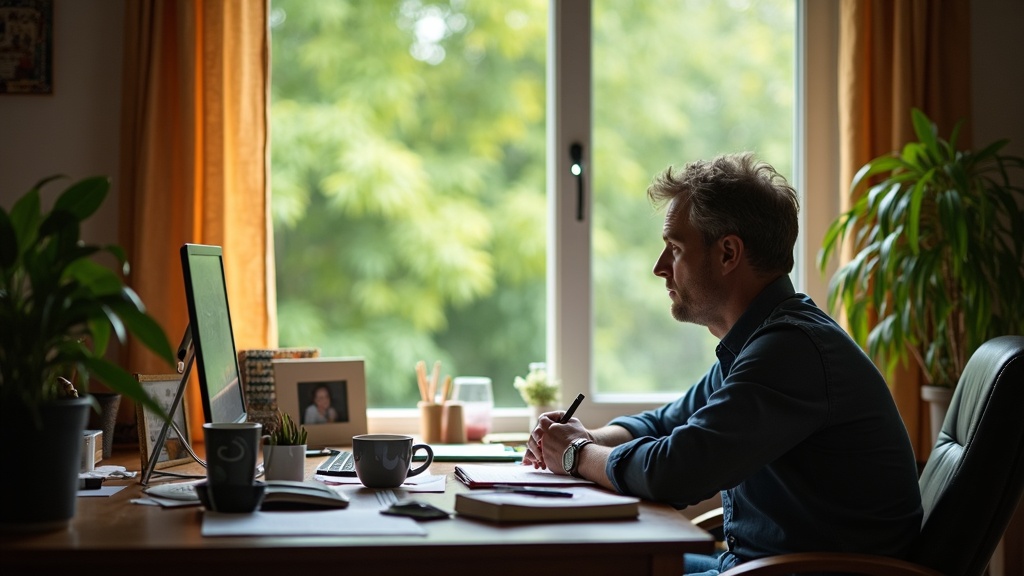
You know you should take breaks. Everyone says so. But when you work from home, breaks feel weirdly impossible.
Your commute used to create natural boundaries. Your coworkers used to interrupt you for coffee. Now you’re just sitting in the same room all day, and stepping away feels like you’re somehow cheating or falling behind.
So you stay glued to your screen. You eat lunch while typing. You tell yourself you’ll take a real break later, but later never comes. By three in the afternoon, your brain feels like scrambled eggs and you’ve somehow been sitting for six hours straight.
The problem isn’t that you lack discipline. It’s that working from home erased all the structures that used to force breaks to happen naturally. You have to build new ones yourself, and nobody really explains how to do that without overhauling your entire life or buying a meditation cushion.
This isn’t another article about the importance of self-care or the benefits of mindfulness. You already know breaks are good for you. What you need are actual methods that work in a home office where your kitchen is ten feet away and your boss can see when you’re online.
The good news is that effective breaks don’t require big changes or special equipment. They just require knowing what actually counts as a break, and having a few simple tactics to make them happen without guilt.
Why breaks feel harder at home than in an office
In an office, breaks happen naturally. Someone stops by your desk. You walk to a meeting. You grab coffee with a coworker. These little interruptions pull you away from your screen without you even deciding to take a break.
At home, none of that exists. You sit down at your desk in the morning, and the next time you look up, it’s three in the afternoon. There’s no one to interrupt you, no reason to move, and no clear signal that it’s time to pause.
Then there’s the guilt. When you’re visible in an office, people can see you’re busy. At home, you might worry that if you step away, someone will message you and think you’re slacking off. That invisible pressure keeps you glued to your chair, even when your brain is begging for a rest.
Your home environment makes it worse. The couch where you relax at night is ten feet from your desk. The kitchen where you unwind is right there. When work and rest share the same space, your brain never fully separates the two. Taking a break can feel like you’re not really breaking at all.
And then there’s the loop. You tell yourself you’ll stop after you finish this one thing. But that thing leads to another, and another. Before you know it, hours have passed and you haven’t moved.
The result isn’t dramatic. You don’t collapse. But by mid-afternoon, your focus is fuzzy. Tasks take longer. You reread the same email three times. You’re technically working, but you’re running on fumes.
What counts as a real break (and what doesn’t)
A real break changes something about what you’re doing. That’s the simplest way to think about it. If you’ve been sitting and staring at a screen, a break means moving your body, looking at something far away, or stepping into a different room. The point is to give whatever you were using a chance to rest.
What doesn’t count? Switching from your project document to Slack. Reading work emails instead of writing them. Scrolling Twitter on your phone while still planted in your desk chair. These might feel like breaks because they’re different tasks, but your brain and body are doing basically the same thing. You’re still sitting. Still looking at a screen. Still processing information and making small decisions.
Think of it this way: a break changes your input. That could mean your posture, where your attention goes, or what’s around you. Sometimes all three.
Micro-breaks can be as simple as standing up to refill your water or looking out the window for thirty seconds. These are great for resetting your focus when you’re in the middle of something and can’t step away for long. They take almost no time but genuinely help.
Longer breaks might mean leaving your workspace entirely, doing something with your hands that isn’t typing, or having an actual conversation with someone who isn’t a coworker. A ten-minute walk outside hits all three: different posture, different focus, different environment.
The trick isn’t following someone else’s break formula. It’s noticing what you’ve been doing for the past hour and consciously doing something else for a few minutes.
How to make breaks happen when you don’t feel like stopping
The hardest part of taking breaks isn’t knowing you should take them. It’s actually stopping what you’re doing when your brain is locked into work mode. Motivation won’t save you here. You need triggers that work automatically.
The easiest way to build breaks into your day is to attach them to things that already happen. After you finish a meeting, stand up before you check email. After you send a big deliverable, step outside for two minutes before starting the next task. After you make coffee, drink it somewhere other than your desk. These existing moments become natural breaking points without requiring you to remember or decide anything.
You can also use your body as a signal. When you notice you’re rereading the same sentence three times, that’s a cue. When your shoulders creep up toward your ears, that’s another one. Your body usually tells you it needs a break before your mind does. The trick is actually listening instead of pushing through.
Here’s what makes this easier: decide in advance what your break will be. Not every break, just have two or three default options ready. Maybe it’s walking to the end of your street, doing ten pushups, or looking out a window for sixty seconds. When the moment comes, you don’t have to figure out what to do. You just do the thing.
The goal is to remove friction. If stopping feels like a big production that requires planning and effort, you won’t do it. But if it’s just the thing that happens after meetings or when your neck gets tight, it starts to feel automatic. And automatic is exactly what you need when motivation is nowhere to be found.
Physical break ideas that work in small spaces
You don’t need a gym membership or a yoga mat to shake off the stiffness that comes from sitting too long. Most physical breaks that actually help take less than three minutes and require nothing but the space you’re already in.
When your neck feels tight or your shoulders are creeping up toward your ears, stand up and reach your arms overhead. Roll your shoulders back a few times. Turn your head slowly from side to side. The goal isn’t a workout. It’s just reminding your body it can move.
If you’re feeling restless or stuck on a problem, change rooms entirely. Walk to the kitchen and refill your water. Step outside your front door for thirty seconds of fresh air. Even moving to a different chair can reset your mental state more than you’d expect.
When you notice yourself getting sleepy in the afternoon, try a quick tidy instead of reaching for more coffee. Washing a few dishes or clearing your desk gives your brain something physical to focus on. The small accomplishment often brings a surprising lift in energy.
For eye strain, look out a window at something far away. Let your eyes relax on a tree or a building across the street for twenty seconds. Your eyes get tired from staring at a screen inches from your face, and distance gives them a break.
If you feel wound up or anxious, take three slow breaths with your shoulders dropped. Breathe in for four counts, out for six. It sounds too simple to work, but it interrupts the physical tension that builds when you’re stressed.
The best physical break is whichever one you’ll actually do. Pick the easiest option for how you’re feeling right now, not the one that sounds most impressive.
Mental breaks that don’t turn into a 45-minute distraction
The problem with most mental breaks is that they’re either too vague or too tempting. You tell yourself you’ll “just check social media for a second,” and suddenly it’s been forty minutes and you feel worse than before you started.
The trick is choosing something specific with a natural stopping point built in. Listen to one song you actually like, not a playlist. Make tea and actually pay attention to making it instead of scrolling while the kettle boils. Read one chapter of a book that has nothing to do with work, or step outside and notice three specific things about what you see.
These work because they give your brain something to do that isn’t work, but they don’t suck you into an endless scroll. A single song ends. A cup of tea gets made. You notice three things and you’re done.
If you need to process something that’s been nagging at you, try writing it down for two minutes. Not solving it, just getting it out of your head and onto paper. This parks the thought so you can come back to it later without it buzzing around while you’re trying to work.
The key is deciding what you’ll do before you take the break. Pick one thing, know when it ends, and if your phone is the problem, leave it in another room. You’re not trying to achieve perfect mindfulness or fix your whole life. You’re just giving your attention a place to rest that isn’t work and isn’t a guilt spiral.
A simple break rhythm you can repeat in a work from home routine
The easiest way to build break habits is to stop thinking about a perfect schedule and start noticing the natural gaps in your day. Between finishing one task and starting another, you already have tiny windows. Use them. Stand up, stretch your arms overhead, look out a window for ten seconds. That’s it.
These micro-breaks cost almost nothing, but they reset your focus before it completely drains. You’re not trying to relax deeply or solve anything. You’re just giving your brain a moment to shift gears.
Once a day, usually around midday when your energy starts sagging, take a longer reset. This could be fifteen minutes or thirty, depending on what your calendar allows. The key is doing something that pulls you completely away from your screen. Walk around the block, make actual lunch instead of eating at your desk, or sit outside if the weather’s decent.
Pick your timing based on when you typically hit a wall. If you’re drowsy after lunch, that’s your window. If you have back-to-back meetings until two, then two-thirty works fine. There’s no magic hour.
At the end of your workday, create one small ritual that marks the transition out of work mode. Change your clothes, take a quick walk, or do five minutes of something physical. This isn’t about wellness points. It’s a signal to your brain that work is over, which matters more when your office is also your living room.
On packed days when meetings swallow your time, don’t abandon the rhythm entirely. Even two-minute breaks between calls make a difference. Flexibility beats perfection every time.







